12 Things No One Tells You About Owning a Home (2027)
The thing no one tells you about owning a home is that the costs keep coming after closing day. Maintenance runs about 1% to 4% of the home's value every year, according to Fannie Mae's rule of thumb. Property tax bills rise with annual reassessments, insurance reprices at every renewal, and the coastal climate is hard on air conditioners and crawlspaces. This guide covers 12 of these surprises for buyers planning a 2027 purchase in Hampton Roads. Figures are current as of October 29, 2026.
Key takeaways at a glance
- Budget 1% to 4% of home value per year for maintenance. On a $440,000 home that is $4,400 to $17,600. Lean toward the high end once the house is more than 30 years old.
- Closing costs come back when you refinance (Freddie Mac puts it at 3% to 6% of the loan) and when you sell.
- Virginia Beach, Chesapeake and Norfolk reassess every year. Virginia Beach held its rate at $0.97 for FY 2026-27, but the median assessment still rose 5.23%.
- Coastal wear is real. Salt air corrodes outdoor HVAC coils, and humidity works on crawlspaces.
- Insurance reprices every year. Most NFIP flood policies still below their full-risk rate can rise up to 18% a year until they get there.
| Surprise | Impact | Annual Budget Item? |
|---|---|---|
| Maintenance reality (1–4% of value) | High | Yes, separate fund |
| Property tax escalation | Medium | Yes, escrow is recalculated each year |
| Insurance premium increases | Medium | Yes, shop at renewal |
| HVAC wear in a coastal climate | High | Maintenance reserve |
| Crawlspace moisture issues | Medium | Inspection check |
| HOA special assessments | Medium | Read the resale certificate and reserve study |
| Closing costs come back at refinance / sale | Medium | Plan ahead |
| Wire fraud attempts | Critical | Verify by phone |
In this guide
- Key takeaways at a glance
- 1. Maintenance is real and expensive
- 2. Closing costs come back
- 3. Property tax bills rise with your assessment
- 4. Insurance premiums reprice every year
- 5. Coastal salt air is hard on HVAC
- 6. Crawlspaces need attention
- 7. Yard care is a real expense
- 8. HOA dues can rise, and assessments happen
- 9. Utilities may be higher than expected
- 10. Tax deductions may be smaller than promised
- 11. Wire fraud is constantly attempted
- 12. Every repair is now your call
- FAQ
- Sources & further reading
1. Maintenance is real and expensive
Fannie Mae's rule of thumb is to budget 1% to 4% of your home's value each year for maintenance, repairs and replacements. Newer homes sit near 1%. Fannie Mae suggests leaning toward 4% once a home is more than 30 years old. In Virginia Beach, where the median sold price was $442,500 in September 2026 (VaHome analysis of REIN MLS data, September 2026), that works out to roughly $4,400 a year on a newer house and much more on an older one.
The money rarely goes out evenly. You may spend little for two years and then replace a water heater and a section of roof in the same season. Keep the fund in a separate account so it is there when you need it. Our seasonal home maintenance checklist for Hampton Roads lays out what to do and when.
2. Closing costs come back
Freddie Mac says buyers should be prepared to pay 2% to 5% of the purchase price in closing costs, and that refinancing typically costs 3% to 6% of the loan principal. A refinance only pays off if the lower payment covers those costs before you sell or refinance again.
Selling has its own costs: agent compensation (which is negotiable), your share of settlement fees, and Virginia's grantor tax of 50 cents per $500 of value, which the seller pays unless the contract says otherwise (Va. Code § 58.1-802). On a $440,000 sale the grantor tax alone is $440.
3. Property tax bills rise with your assessment
Virginia Beach, Chesapeake and Norfolk reassess every property every year, and new values apply to the fiscal year that starts July 1. A flat tax rate does not mean a flat bill. For FY 2026-27, Virginia Beach kept its rate at $0.97 per $100, but the city assessor reported a median assessment increase of 5.23% across all property types, down from the double-digit increases of 2023. Your bill rises with your assessment unless the rate is cut.
If you pay taxes through escrow, your lender recalculates the escrow payment each year, so a higher bill shows up as a higher mortgage payment. Look up the current rate, assessor and appeal deadlines for your city on our Virginia Beach property records and tax rate page or the matching page for your city.
4. Insurance premiums reprice every year
Homeowners and flood policies reprice at every renewal. The most recent National Association of Insurance Commissioners state figures published by the Insurance Information Institute put the average Virginia homeowners premium at $1,332 in 2022, against $1,569 nationally. Nationally, the average HO-3 premium rose 11.26% from 2021 to 2022. Coastal ZIP codes, older roofs and higher rebuild costs push quotes up from there, so get quotes before you write an offer.
Flood insurance is separate, because standard homeowners policies do not cover flooding. FEMA's Risk Rating 2.0 pricing applied to new NFIP policies from October 1, 2021 and to renewals from April 1, 2022. Most policies that are below their full-risk rate can rise up to 18% a year, plus fees, until they reach it. As of FEMA's April 2025 profile, Virginia had about 104,800 NFIP policies in force. New NFIP policies usually carry a 30-day waiting period, so do not wait for a storm to buy one. Our guide on how to check flood zones in Norfolk and Virginia Beach walks through the map lookup.
5. Coastal salt air is hard on HVAC
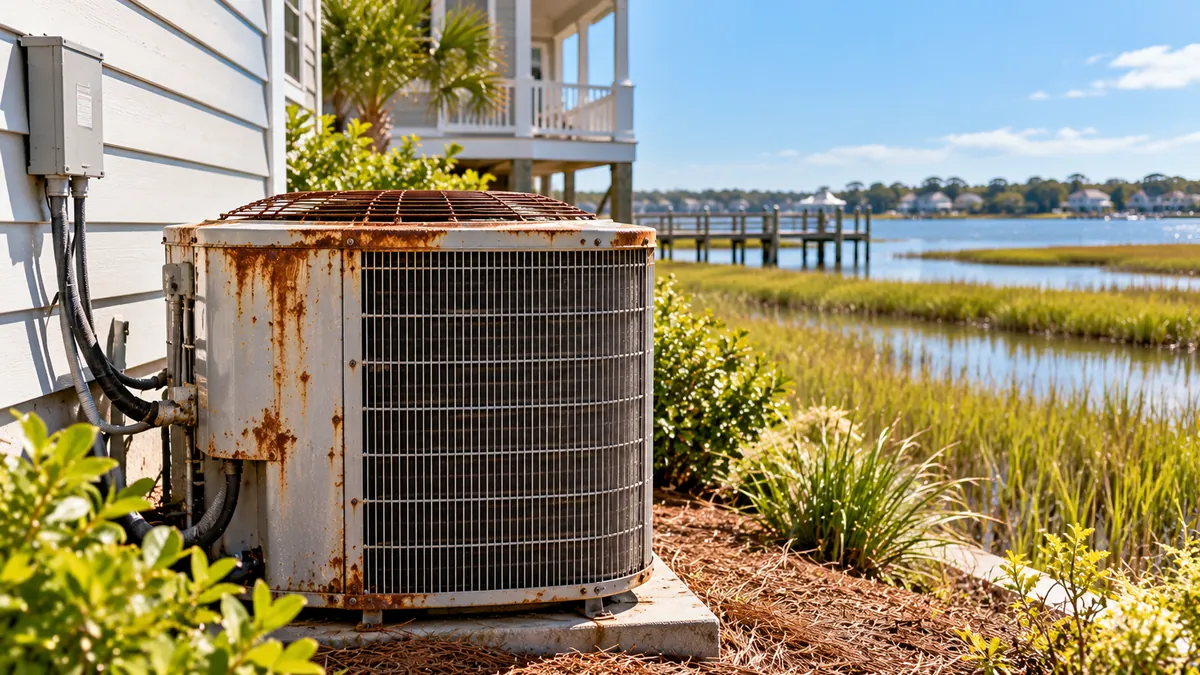
Carrier notes that salt-laden air can be carried as far as two miles inland and that standard copper-aluminum coils can suffer galvanic corrosion, which leads to refrigerant leaks. Some manufacturers, including Carrier, sell coastal models with corrosion-resistant coils and a separate seacoast-corrosion warranty. ENERGY STAR suggests considering replacement once a heat pump or air conditioner is more than 10 years old, especially if repairs are frequent and bills are climbing.
When you buy, ask for the age of the outdoor unit (it is usually on the data plate), the last service date, and whether the coil has been replaced. Keep the outdoor coil clean, change filters on schedule, and build the replacement into your maintenance fund early.
6. Crawlspaces need attention
Homes built over vented crawlspaces take in humid summer air, and the space stays damp. The EPA recommends keeping indoor humidity below 60%, ideally between 30% and 50%, to limit mold growth. Torn vapor barriers, standing water and wet insulation are things your home inspector should look for.
Fixes range from a new vapor barrier and better drainage to full encapsulation with a dehumidifier. Costs depend on the size of the space and how much water is getting in, so get at least two written quotes and ask your inspector what is causing the moisture before you pay for a fix.
7. Yard care is a real expense
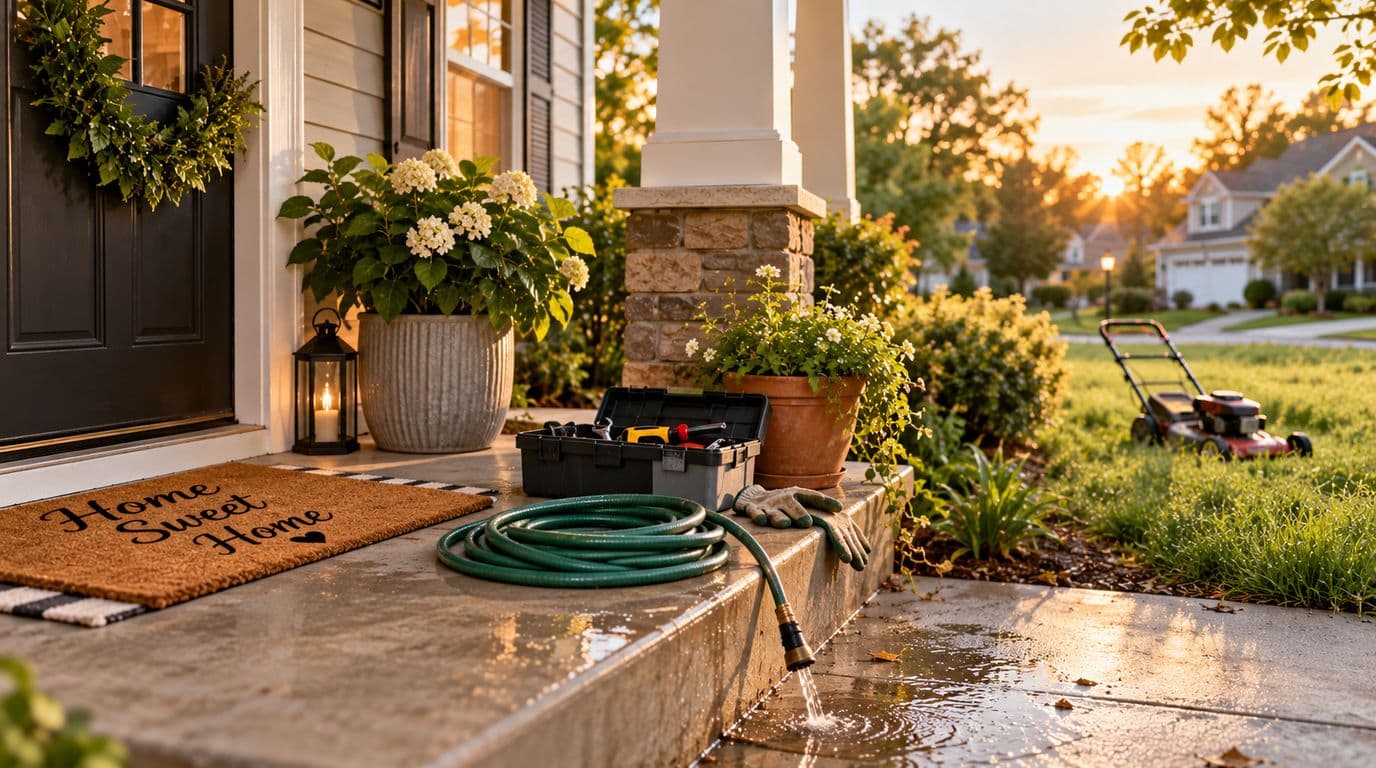
A first house often comes with a mower, trimmer, blower, fertilizer, mulch, and possibly an irrigation system that needs to be drained or winterized before freezing weather. If you hire it out, mowing, pest control and gutter cleaning become monthly bills. Get quotes for the services you will actually use and add them to your budget before you choose a home with a big lot.
8. HOA dues can rise, and assessments happen
Condominiums and many newer Hampton Roads subdivisions have an owners association. Boards can raise dues and approve special assessments for roofs, pools, roads or other big projects. Under Virginia's Resale Disclosure Act, the resale certificate must include the current operating budget, the current reserve study or a summary of it, approved capital expenditures, any approved special assessments, and pending lawsuits that could affect owners (Va. Code § 55.1-2310).
Read it closely. If the ratified contract does not set a different period, you have three days after receiving the certificate to cancel without penalty and get your deposit back (Va. Code § 55.1-2312).
9. Utilities may be higher than expected
The average Virginia household used about 1,032 kWh of electricity a month in 2024 and paid an average of $148.77 a month, according to the U.S. Energy Information Administration. Summer bills in a large or older house can run well above that. For Dominion Energy Virginia customers, the State Corporation Commission's November 25, 2025 order raised the monthly bill for a typical residential customer using 1,000 kWh by $11.24 in 2026 and another $2.36 in 2027.
Before you buy, ask the seller for 12 months of electric, gas and water bills. Water, sewer and trash charges are set locally and differ from one city to the next.

10. Tax deductions may be smaller than promised
Mortgage interest and property taxes only lower your federal tax if you itemize, and itemizing only helps when your deductions beat the standard deduction. For tax year 2026, the standard deduction is $16,100 for single filers and $32,200 for married couples filing jointly (IRS, October 9, 2025). The IRS had not released its 2027 figures as of October 29, 2026. It usually announces them in the fall.
Three rules matter for homeowners. Mortgage interest is deductible on up to $750,000 of acquisition debt taken out after December 15, 2017. The state and local tax deduction is capped at $40,400 for 2026 and is reduced once modified adjusted gross income passes $505,000. Mortgage insurance premiums are deductible again starting with tax year 2026, subject to an income phaseout, according to the IRS draft 2026 Publication 936. Run the numbers with a tax professional before you count on a deduction, and see our guide to the tax benefits of owning a home in Virginia.
11. Wire fraud is constantly attempted
The FBI's Internet Crime Complaint Center logged 12,368 real estate fraud complaints in 2025 with reported losses of $275.1 million, up from $173.6 million in 2024. That category also covers rental and timeshare fraud. Closing-funds scams usually arrive as an email that looks like it came from your title company, lender or agent, with "updated" wiring instructions.
Verify any wiring instructions by calling a number you already know is real, never one from the email itself. The attempts do not stop at closing. Treat any later email asking you to send money for your mortgage, taxes or insurance the same way.
12. Every repair is now your call
There is no landlord to call. When the water heater leaks on a Sunday, you find the plumber, approve the price and pay the bill. Keep a short list of trusted contractors before you need one, know where your main water shutoff and electrical panel are, and keep your closing documents and warranties in one place. Most owners say the control is worth it, as long as they planned for the cost.
Frequently Asked Questions
How much should I budget for home maintenance per year?
Fannie Mae's rule of thumb is 1% to 4% of the home's value each year, with 1% for newer homes and closer to 4% for homes more than 30 years old. On a $440,000 home that is $4,400 to $17,600 a year. Keep it in a separate account.
Do property taxes really go up every year in Hampton Roads?
Often, yes. Virginia Beach, Chesapeake and Norfolk reassess every year. For FY 2026-27, Virginia Beach kept its $0.97 rate but the median assessment rose 5.23%, so many bills went up even with no rate change.
Why does HVAC wear faster near the coast?
Salt air corrodes outdoor coils. Carrier notes that salt can travel as far as two miles inland and that standard copper-aluminum coils can suffer galvanic corrosion. ENERGY STAR suggests considering replacement once a system is more than 10 years old.
Should I encapsulate my crawlspace?
Only after you know why it is wet. The EPA recommends indoor humidity below 60%, ideally 30% to 50%. Some crawlspaces need only a new vapor barrier or better drainage, and others benefit from full encapsulation with a dehumidifier. Get an inspector's view and at least two written quotes.
How much do utilities run in a typical Hampton Roads home?
The average Virginia residential electric bill was $148.77 a month in 2024 (EIA), with about 1,032 kWh of use. Large or older homes can run well above that in summer. Ask the seller for 12 months of bills, and budget for Dominion's approved base-rate increases in 2026 and 2027.
Does owning a home really save on taxes?
Only if your itemized deductions beat the standard deduction, which is $32,200 for married couples filing jointly in tax year 2026. Many owners take the standard deduction instead. Run the math with a tax professional.
Why do flood insurance premiums change year-to-year?
Under FEMA's Risk Rating 2.0, policies below their full-risk rate step up each year, with most increases capped at 18% a year until the full-risk rate is reached. Federal fees and surcharges are not covered by that cap. Private flood policies are priced by each insurer at renewal.
Is the HOA fee fixed?
No. Boards can raise dues and approve special assessments. The resale certificate shows the budget, the reserve study or its summary, and any approved special assessments, and in Virginia you can cancel within three days of receiving it unless your contract sets a different period.
Have a question about your home purchase?
Talk to a Hampton Roads buyer's agent or loan officer who can walk through your specific situation - no pressure, no obligation.
Sources & further reading
- Fannie Mae: How to build your maintenance and repair budget
- Freddie Mac: What are closing costs? and the costs of refinancing
- Va. Code § 58.1-802: grantor tax
- City of Virginia Beach: FY27 Real Estate Assessor's annual report (February 24, 2026)
- Insurance Information Institute: homeowners insurance facts and statistics
- FEMA: Risk Rating 2.0 frequently asked questions
- FEMA — Flood Map Service Center
- Carrier: coastal heating and air
- ENERGY STAR: When is it time to replace?
- ENERGY STAR — Save at home
- EPA: A brief guide to mold, moisture and your home
- Va. Code § 55.1-2312: resale certificate and right to cancel
- U.S. EIA: electric sales, revenue and average price (2024 data)
- Cardinal News: regulators approve Dominion Energy rate increase (November 26, 2025)
- IRS: tax year 2026 inflation adjustments
- IRS: 2026 state and local tax deduction limit
- IRS: draft 2026 Publication 936, Home Mortgage Interest Deduction
- FBI IC3: 2025 Internet Crime Report
- CFPB — Owning a home
- The real yearly costs of owning a home
Figures are as of October 29, 2026, and each carries its own date above. Always confirm current details with the relevant agency, lender, or licensed professional before relying on any specific figure or rule.
About the Author
Tom & Dariya Milan are a husband-and-wife team of licensed Virginia real estate agents serving Hampton Roads since 2005. Tom handles listing strategy, pricing and negotiation; Dariya handles buyers, contract-to-close and relocations. Their closings and reviews, pulled from the MLS, are on the About page. Brokered by LPT Realty. Call (757) 777-7577 or email tom@vahome.com.
About the Hampton Roads Real Estate Market
Hampton Roads is one of the most dynamic real estate markets on the East Coast, anchored by the largest naval complex in the world at Naval Station Norfolk and home to roughly 120,000 active-duty, reserve, and civilian Department of Defense personnel. The region spans seven cities — Virginia Beach, Norfolk, Chesapeake, Suffolk, Portsmouth, Hampton, and Newport News — plus the Peninsula communities of Williamsburg, Yorktown, and Poquoson, with each market carrying its own personality, school district, and price profile.
Buying or selling here means thinking about more than just a house. Tidewater geography means flood zones, hurricane preparation, and waterfront premiums matter. Military presence means BAH affordability, PCS season inventory crunches (May through August), and VA loan eligibility are top of mind for a meaningful share of every neighborhood. School quality varies block by block, especially across the seven independent city school divisions, and is often the deciding factor for relocating families.
Why Buyers and Sellers Choose VaHome
Tom & Dariya Milan, Realtors focus on the Hampton Roads region with deep expertise in military relocation, VA financing, and the trade-offs that local buyers actually face. From listing strategy that gets your home in front of the right relocating buyer to buyer representation that respects your BAH cap and PCS timeline, the team treats every transaction as a long-term relationship. The site is built to make decisions clearer: BAH-aware search, drive-time mapping to every major installation, neighborhood guides written by people who live here, and a calculator that shows real monthly cost — taxes, insurance, HOA, and PMI included — instead of a teaser headline number. Brokered by LPT Realty.
Plan Your Next Move
Whether you are buying your first home with a VA loan, moving up while your kids transition between school districts, or selling a Hampton Roads property to relocate to your next duty station, the resources on this site are organized around the questions you are actually asking. Browse listings filtered by base proximity, paygrade-aware BAH cap, and commute time. Read neighborhood guides for Virginia Beach, Norfolk, Chesapeake, Suffolk, Hampton, Newport News, Williamsburg, and the Peninsula communities. Use the mortgage calculator to compare conventional, FHA, VA, USDA, and jumbo loan scenarios side by side. When you are ready to talk, the contact form goes directly to a specialist who knows the area, the lenders, and the timing.