FEMA Flood Zone Designations: What They Mean for Homeowners
FEMA flood zone designations are official map boundaries that determine mandatory flood insurance requirements and influence lender underwriting. For homeowners in Hampton Roads, these zones decide whether a federally backed mortgage requires flood insurance, which in turn affects monthly costs. Understanding these designations is critical for anyone buying, selling, or refinancing property in Virginia Beach, Norfolk, or Chesapeake. Tom & Dariya Milan, Realtors, provide local context to help you interpret these federal maps accurately.
The Anatomy of a Flood Zone
Zone AE and Zone A
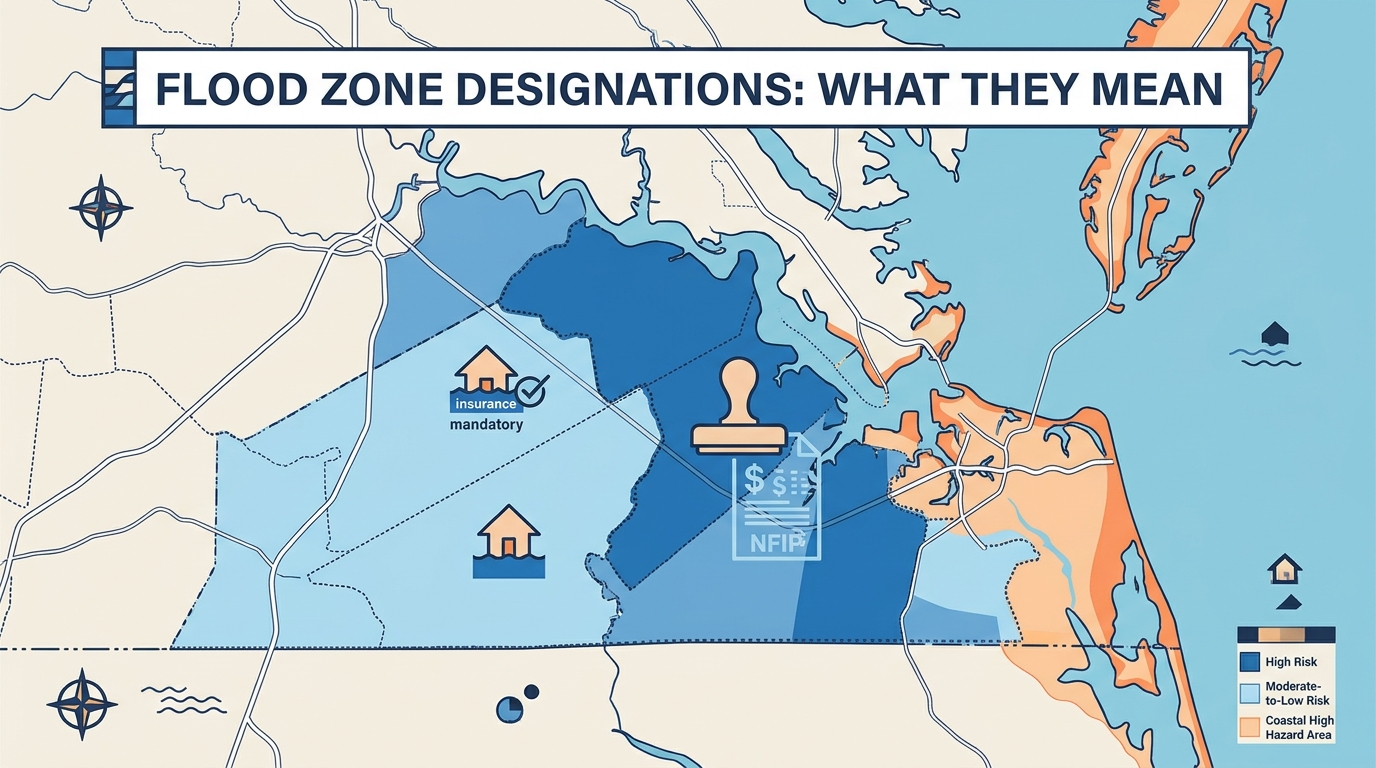
Zone AE is a high-risk area where Base Flood Elevations (BFE) are determined. Zone A is also high-risk but lacks specific BFE data. Properties in these zones require mandatory flood insurance if the home is financed with a federally regulated lender. This requirement is not optional; it is a condition of the loan.
Zone X (Shaded and Unshaded)
Zone X (shaded) represents a moderate-risk area with a 0.2% annual chance of flooding. Zone X (unshaded) is a minimal-risk area. While insurance is not federally mandated in these zones, a lender can still require it, and homeowners may choose to purchase coverage for financial protection.
Zone V and Zone VE
Zone V and Zone VE are high-risk coastal areas subject to wave action. These zones are found along the oceanfront and the Chesapeake Bay shoreline in Virginia Beach and Norfolk. The presence of wave action can significantly increase insurance premiums compared to inland Zone AE properties.
How Designations Affect Insurance Costs
The flood zone decides whether insurance is required; the premium is set property by property. Under FEMA's Risk Rating 2.0, National Flood Insurance Program (NFIP) pricing weighs distance to water, the type and frequency of flooding, the home's elevation and the cost to rebuild. The BFE, the elevation to which floodwater is expected to rise during a 1% annual chance flood, still matters: a home that sits lower relative to the BFE will generally face higher premiums. In Hampton Roads, coastal properties in Zone VE often see premiums that are substantially higher than those in inland Zone AE areas. Ask an insurance agent for an NFIP quote and a private flood quote before closing to understand the true cost of ownership.
It is important to note that flood insurance is separate from standard homeowners insurance. Standard policies typically exclude flood damage. Therefore, a homeowner in a high-risk zone with a federally backed mortgage must carry a separate flood policy. The cost of this policy should be factored into the monthly budget alongside the mortgage payment, property taxes, and homeowners association fees.
Impact on Property Value and Resale
Flood zone designations can influence property value, though the impact varies by neighborhood and market conditions. Buyers are often cautious about properties in high-risk zones due to the added cost of insurance and potential maintenance issues. However, well-maintained homes in flood zones can still command strong prices, especially in desirable locations. In Virginia, the standard residential disclosure statement tells buyers to do their own flood zone research, and a seller who knows the home is a repetitive risk loss structure must disclose that. Sellers should also be ready to share documentation of any flood mitigation measures, such as an elevation certificate or flood vents.
When listing a home, Tom & Dariya Milan, Realtors, review the flood zone status and provide context to potential buyers. This transparency helps manage expectations and can prevent surprises during the inspection period. Understanding how the designation affects the local market is key to pricing a home competitively.
Verifying Your Property's Flood Zone
Homeowners can verify their property's flood zone on the FEMA Flood Map Service Center, which displays the National Flood Hazard Layer. You enter an address and view the official flood zone designation and, where one is published, the BFE. Every listing page on VaHome.com also shows the home's FEMA zone, and our guide to checking flood zones in Norfolk and Virginia Beach walks through the steps. It is important to use the most current map panels, as FEMA periodically revises maps based on new data. If a property is near a zone boundary, an elevation certificate from a licensed surveyor may be needed to determine the exact status.
Additionally, lenders use their own underwriting guidelines, which may be stricter than FEMA's minimum requirements. A lender may require flood insurance even if the property is in a moderate-risk zone. Homeowners should confirm their lender's specific requirements during the loan application process. This step ensures there are no surprises at closing.
Key Takeaways
- FEMA flood zone designations are official map boundaries that determine mandatory flood insurance requirements.
- Zone AE and Zone A are high-risk areas that require flood insurance for federally regulated loans.
- Zone V and Zone VE are coastal high-risk areas subject to wave action, often resulting in higher premiums.
- Flood insurance is separate from standard homeowners insurance and is purchased as its own policy.
- A home's elevation relative to the Base Flood Elevation (BFE) is a key factor in flood insurance premiums.
- Homeowners can verify their flood zone on the FEMA Flood Map Service Center.
- Lenders may have stricter insurance requirements than FEMA's minimum standards.
Frequently Asked Questions
What is a Base Flood Elevation (BFE)?
A Base Flood Elevation (BFE) is the height, in feet, to which floodwater is expected to rise during a 1% annual chance flood. It is used in building code requirements and is one input to flood insurance pricing.
Do I need flood insurance if I am in Zone X?
Flood insurance is not federally mandated in Zone X, but a lender can still require it. Homeowners in Zone X may choose to purchase coverage for financial protection, as flood damage is not covered by standard homeowners insurance.
How does a flood zone affect my mortgage?
If your property is in a high-risk zone (Zone A, AE, V, or VE) and you have a federally regulated mortgage, you are required to purchase flood insurance. The cost of this insurance is added to your monthly housing expenses.
Can I appeal my flood zone designation?
Yes. If you believe your home sits above the mapped flood level, you can ask FEMA for a Letter of Map Amendment (LOMA), supported by evidence such as an elevation certificate from a licensed surveyor.
Where can I check my property's flood zone?
You can check your property's flood zone on the FEMA Flood Map Service Center. It shows the official flood zone designation for a mapped address and, where one is published, the Base Flood Elevation.
Next Steps for Hampton Roads Homeowners
Understanding FEMA flood zone designations is a critical step in managing your property's financial and physical risks. By verifying your zone, understanding insurance requirements, and considering the impact on resale value, you can make informed decisions about your home. Tom & Dariya Milan, Realtors, are available to guide you through this process and provide local market insights. Contact Tom & Dariya to discuss your property. If you are buying rather than selling, see what flood zone designations mean for Hampton Roads buyers.
Disclaimer: Tom & Dariya Milan, Realtors. Brokered by LPT Realty. Licensed real estate agents in Virginia. 249 Central Park Ave, Ste 300-220, Virginia Beach, VA 23462. (757) 777-7577. VaHome.com. Equal Housing Opportunity. Listing data comes from the REIN MLS and is deemed reliable but not guaranteed; prices and availability can change.
About the Author
Tom & Dariya Milan are a husband-and-wife team of licensed Virginia real estate agents serving Hampton Roads since 2005. Tom handles listing strategy, pricing and negotiation; Dariya handles buyers, contract-to-close and relocations. Their closings and reviews, pulled from the MLS, are on the About page. Brokered by LPT Realty. Call (757) 777-7577 or email tom@vahome.com.
About the Hampton Roads Real Estate Market
Hampton Roads is one of the most dynamic real estate markets on the East Coast, anchored by the largest naval complex in the world at Naval Station Norfolk and home to roughly 120,000 active-duty, reserve, and civilian Department of Defense personnel. The region spans seven cities — Virginia Beach, Norfolk, Chesapeake, Suffolk, Portsmouth, Hampton, and Newport News — plus the Peninsula communities of Williamsburg, Yorktown, and Poquoson, with each market carrying its own personality, school district, and price profile.
Buying or selling here means thinking about more than just a house. Tidewater geography means flood zones, hurricane preparation, and waterfront premiums matter. Military presence means BAH affordability, PCS season inventory crunches (May through August), and VA loan eligibility are top of mind for a meaningful share of every neighborhood. School quality varies block by block, especially across the seven independent city school divisions, and is often the deciding factor for relocating families.
Why Buyers and Sellers Choose VaHome
Tom & Dariya Milan, Realtors focus on the Hampton Roads region with deep expertise in military relocation, VA financing, and the trade-offs that local buyers actually face. From listing strategy that gets your home in front of the right relocating buyer to buyer representation that respects your BAH cap and PCS timeline, the team treats every transaction as a long-term relationship. The site is built to make decisions clearer: BAH-aware search, drive-time mapping to every major installation, neighborhood guides written by people who live here, and a calculator that shows real monthly cost — taxes, insurance, HOA, and PMI included — instead of a teaser headline number. Brokered by LPT Realty.
Plan Your Next Move
Whether you are buying your first home with a VA loan, moving up while your kids transition between school districts, or selling a Hampton Roads property to relocate to your next duty station, the resources on this site are organized around the questions you are actually asking. Browse listings filtered by base proximity, paygrade-aware BAH cap, and commute time. Read neighborhood guides for Virginia Beach, Norfolk, Chesapeake, Suffolk, Hampton, Newport News, Williamsburg, and the Peninsula communities. Use the mortgage calculator to compare conventional, FHA, VA, USDA, and jumbo loan scenarios side by side. When you are ready to talk, the contact form goes directly to a specialist who knows the area, the lenders, and the timing.