
Shortest Commutes to Naval Station Norfolk: Hampton Roads Neighborhood Guide
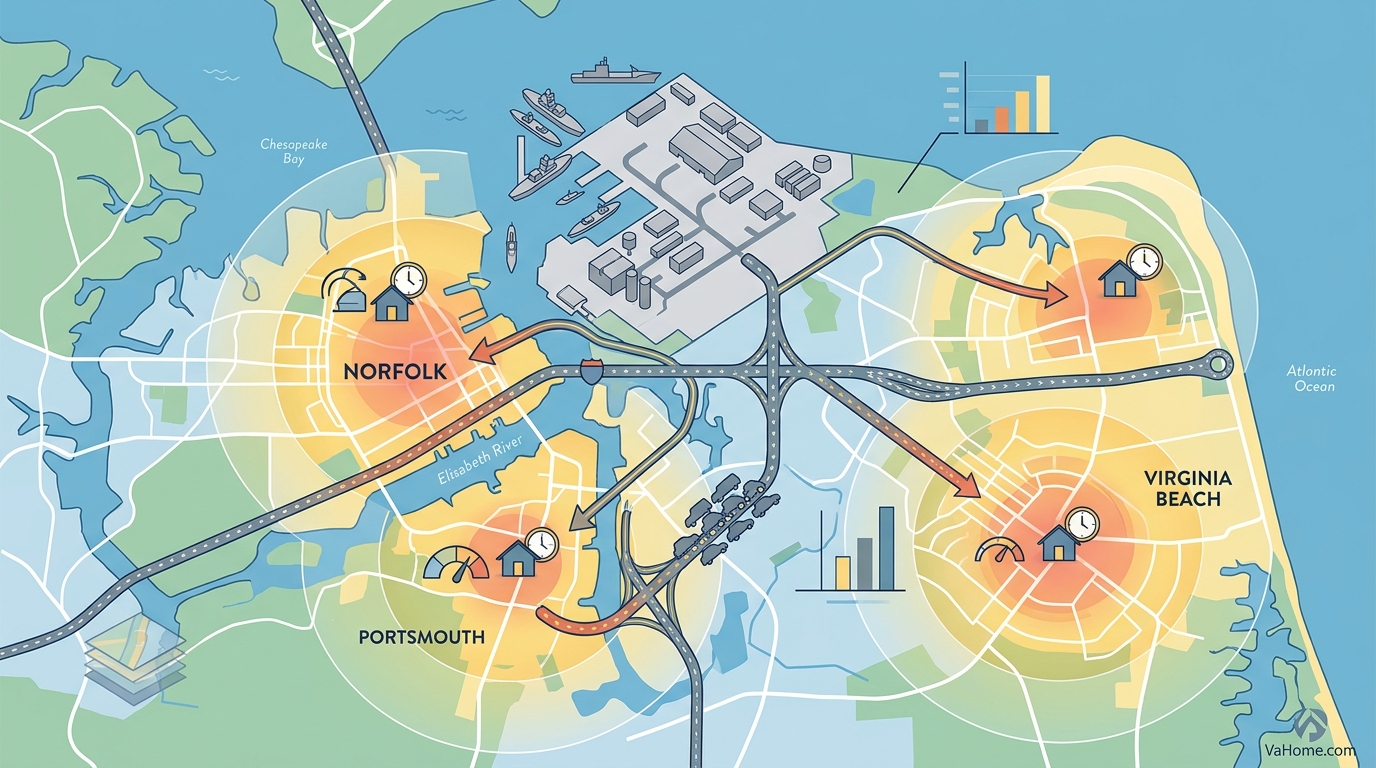
Neighborhoods in Norfolk, Portsmouth, and southern Virginia Beach offer the shortest drives to Naval Station Norfolk. The specific route and traffic conditions determine your actual travel time. This guide explains how to evaluate commute times, verify local data, and choose a location that fits your schedule. Tom & Dariya Milan, Realtors, provides local expertise to help you navigate these options.
How to Choose a Neighborhood
Choosing a neighborhood based on commute requires looking beyond the straight-line distance. You must evaluate the specific road network connecting your potential home to the base gates. A neighborhood might be geographically close but separated by a highway with heavy congestion or a lack of direct arterial roads.
Evaluating Road Infrastructure
Look for neighborhoods with direct access to major arteries like I-664, I-264, or the Hampton Bridge. These routes often provide more consistent travel times than local surface streets. Consider the number of traffic signals between your home and the base. Fewer signals generally mean less variability in your daily drive.
Assessing Traffic Patterns
Commute times vary significantly by time of day. A 15-minute drive at 10:00 AM might take 35 minutes at 7:30 AM. You should test the drive during your actual shift start times. This helps you understand the realistic daily experience rather than relying on average estimates.
What to Ask Before Committing
Before signing a lease or purchase agreement, ask specific questions about the commute. Inquire about the primary route used by other residents. Ask if there are known construction projects or recurring traffic bottlenecks on that route.
Questions for Sellers and Agents
Ask the seller or listing agent about the typical morning and evening commute times. Request data on how long the drive takes during peak hours. Ask if the neighborhood has a history of flooding that might impact road access. These details help you make an informed decision.
Questions for Local Residents
Connect with current residents in the area. Ask them about their daily commute experience. Inquire about any recent changes to traffic patterns or road conditions. Their firsthand accounts provide valuable context that data tools might miss.
How to Verify Commute Data
Online mapping tools provide estimates, but you should verify this data with real-world testing. Use multiple mapping services to compare their suggested routes and estimated times. Look for discrepancies between different tools, as they may prioritize different road types.
Using Mapping Tools Effectively
Enter your specific home address and the specific base gate you use. Do not just use the general base location. Different gates have different access roads. Test the drive during different times of day to get a full picture of the commute.
Checking Local News and Alerts
Monitor local news for road closures or construction updates. Check the Virginia Department of Transportation website for planned projects. These sources provide up-to-date information that mapping tools might not reflect immediately.
How the Commute Process Works
Your daily commute involves a sequence of steps that you should understand. You leave your home, navigate local streets, merge onto arterial roads, and arrive at the base gate. Each step has its own potential for delay.
Typical Commute Sequence
The process starts with leaving your home. You then travel on local roads to reach a main artery. From there, you drive to the base perimeter. Finally, you pass through the gate and park. Understanding this sequence helps you identify where delays are most likely to occur.
Time Management
Build a buffer into your schedule. If your estimated commute is 20 minutes, plan for 30. This buffer accounts for unexpected delays. It reduces stress and ensures you arrive on time for your shift.
What It Costs
Direct Costs
Fuel is the most obvious cost. Calculate your vehicle's miles per gallon and multiply by the round-trip distance. Add this to your monthly budget. Vehicle wear and tear also increase with mileage. Regular maintenance costs may rise if you drive more miles.
Indirect Costs
Time is also a cost. A longer commute means less time for other activities. Consider the value of your time when evaluating different neighborhoods. A slightly more expensive home with a shorter commute might be a better overall value.
What Goes Wrong
Ignoring Peak Hours
Many people test their commute during off-peak hours. This gives an unrealistically optimistic estimate. You must test during your actual shift times. This ensures you understand the true daily experience.
Overlooking Road Conditions
Some roads are in poor condition or prone to flooding. These issues can cause significant delays. Check local reports on road conditions before committing to a neighborhood.
Versus Alternatives
Living close to the base is not the only option. You can consider living further away and using public transportation or carpooling. Each alternative has its own trade-offs.
Public Transportation
Hampton Roads has a public transit system. You can use it to commute to the base. This option reduces your fuel costs and vehicle wear. However, it may require more time and planning than driving.
Carpooling
Carpooling with a colleague can reduce your individual costs. It also reduces traffic congestion. This option requires coordination with others but can be a practical solution.
| Option | Pros | Cons |
|---|---|---|
| Living Close | Shortest drive time, less stress | Higher housing costs, limited inventory |
| Public Transit | Lower cost, no parking needed | Longer travel time, fixed schedules |
| Carpooling | Shared costs, reduced traffic | Requires coordination, less flexibility |
For a Specific Situation
Your specific situation affects the best choice. If you work night shifts, traffic patterns may differ. If you have a flexible schedule, you can avoid peak hours. Consider your specific work schedule when choosing a neighborhood.
Night Shift Workers
Night shifts often have lighter traffic. You may find that a longer commute is more manageable at night. Test the drive during your specific shift times to get an accurate estimate.
Flexible Schedules
If you have a flexible schedule, you can choose to commute during off-peak hours. This allows you to live in a more affordable area with a longer distance. You can still enjoy a manageable commute by avoiding rush hour.
Rules and Protections
There are rules and protections that apply to your housing search. Fair housing laws protect you from discrimination. You have the right to choose any neighborhood regardless of your background. Ensure that your search is conducted in compliance with these laws.
Fair Housing Laws
Fair housing laws prohibit discrimination in housing. You cannot be denied housing based on protected characteristics. If you experience discrimination, you can file a complaint with the appropriate agency.
Consumer Protections
You have rights as a consumer in the housing market. You are entitled to accurate information about the property and the neighborhood. Ensure that all claims made to you are verifiable.
Local Specifics
Hampton Roads has specific local factors that affect commutes. The region has a complex network of bridges and tunnels. These can be bottlenecks during peak hours. Understanding these local specifics helps you make a better choice.
Bridges and Tunnels
The Hampton Roads region has several major bridges and tunnels. These structures can experience congestion. Check the status of these structures before your commute. Delays at these points can significantly impact your travel time.
Weather Impact
Weather can affect road conditions in Hampton Roads. Rain and snow can reduce visibility and slow traffic. Plan for these conditions when evaluating your commute. Build extra time into your schedule for bad weather.
Timing Your Move
The timing of your move can affect your commute. Moving during peak construction seasons can lead to more delays. Consider the time of year when planning your move. This helps you anticipate potential disruptions.
Construction Seasons
Road construction often peaks in certain seasons. Check for planned projects in your area. If major construction is scheduled, consider delaying your move or choosing a different route.
Seasonal Traffic
Traffic patterns can change with the seasons. Summer vacation traffic can increase congestion. Winter weather can slow traffic. Be aware of these seasonal variations when planning your commute.
Results Over Time
Your commute experience may change over time. Road improvements or new developments can alter traffic patterns. Monitor your commute regularly to stay informed. Adjust your plans as needed based on changes in the area.
Long-Term Changes
Over the years, the area may see new road projects or developments. These can improve or worsen traffic conditions. Stay informed about local planning and development. This helps you anticipate future changes to your commute.
Adapting to Changes
If your commute becomes less manageable, consider adjusting your route or schedule. You might also consider moving to a different neighborhood. Flexibility is key to maintaining a positive commute experience.
Key Takeaways
- Test your commute during actual shift times, not just off-peak hours.
- Use multiple mapping tools to compare route options and estimates.
- Consider the cost of fuel and vehicle wear when evaluating distance.
- Check local news for road construction and weather alerts.
- Understand the local road network, including bridges and tunnels.
- Build a buffer into your schedule to account for unexpected delays.
- Monitor your commute regularly to adapt to changes over time.
Frequently Asked Questions
What is the shortest commute to Naval Station Norfolk?
The shortest commute is typically from neighborhoods in Norfolk or southern Virginia Beach. These areas are geographically closest to the base. However, traffic conditions can vary, so you should test the drive during your specific shift times.
How do I verify commute times?
You can verify commute times by using multiple mapping tools and testing the drive in real life. Enter your specific home address and base gate into the tools. Then, drive the route during your actual shift times to get an accurate estimate.
How does weather affect the commute?
Weather can significantly impact the commute. Rain and snow can reduce visibility and slow traffic. Plan for these conditions by building extra time into your schedule. Check weather forecasts before you leave.
Are there public transportation options?
Yes, Hampton Roads has a public transit system. You can use it to commute to the base. This option reduces your fuel costs and vehicle wear. However, it may require more time and planning than driving.
How do I choose the right neighborhood?
Choose a neighborhood by evaluating the road infrastructure and traffic patterns. Look for direct access to major arteries. Test the drive during peak hours. Consider the cost and time implications of your choice.
How does timing affect my move?
Timing your move can affect your commute. Moving during peak construction seasons can lead to more delays. Consider the time of year when planning your move. This helps you anticipate potential disruptions.
Conclusion
Choosing the right neighborhood for your commute to Naval Station Norfolk requires careful evaluation. You must consider road infrastructure, traffic patterns, and local specifics. Tom & Dariya Milan, Realtors, can help you navigate these factors. We provide local expertise to help you make an informed decision. To start your search, view homes for sale in Norfolk or explore Portsmouth listings. You can also use our interactive map search to find properties that fit your commute needs. For more information, .
Disclaimer: Tom & Dariya Milan, Realtors. Brokered by LPT Realty. Licensed real estate agents in Virginia. 249 Central Park Ave, Ste 300-220, Virginia Beach, VA 23462. (757) 777-7577. VaHome.com. Equal Housing Opportunity. Listing data comes from the REIN MLS and is deemed reliable but not guaranteed; prices and availability can change.
Browse Norfolk homes for sale
See every active Norfolk listing — pulled live from the REIN MLS and refreshed every 2 minutes — with neighborhood guides, school zones, and current market stats.
View all Norfolk homes for sale →About the Author
Tom & Dariya Milan are a husband-and-wife team of licensed Virginia real estate agents serving Hampton Roads since 2005. Tom handles listing strategy, pricing and negotiation; Dariya handles buyers, contract-to-close and relocations. Their closings and reviews, pulled from the MLS, are on the About page. Brokered by LPT Realty. Call (757) 777-7577 or email tom@vahome.com.
About the Hampton Roads Real Estate Market
Hampton Roads is one of the most dynamic real estate markets on the East Coast, anchored by the largest naval complex in the world at Naval Station Norfolk and home to roughly 120,000 active-duty, reserve, and civilian Department of Defense personnel. The region spans seven cities — Virginia Beach, Norfolk, Chesapeake, Suffolk, Portsmouth, Hampton, and Newport News — plus the Peninsula communities of Williamsburg, Yorktown, and Poquoson, with each market carrying its own personality, school district, and price profile.
Buying or selling here means thinking about more than just a house. Tidewater geography means flood zones, hurricane preparation, and waterfront premiums matter. Military presence means BAH affordability, PCS season inventory crunches (May through August), and VA loan eligibility are top of mind for a meaningful share of every neighborhood. School quality varies block by block, especially across the seven independent city school divisions, and is often the deciding factor for relocating families.
Why Buyers and Sellers Choose VaHome
Tom & Dariya Milan, Realtors focus on the Hampton Roads region with deep expertise in military relocation, VA financing, and the trade-offs that local buyers actually face. From listing strategy that gets your home in front of the right relocating buyer to buyer representation that respects your BAH cap and PCS timeline, the team treats every transaction as a long-term relationship. The site is built to make decisions clearer: BAH-aware search, drive-time mapping to every major installation, neighborhood guides written by people who live here, and a calculator that shows real monthly cost — taxes, insurance, HOA, and PMI included — instead of a teaser headline number. Brokered by LPT Realty.
Plan Your Next Move
Whether you are buying your first home with a VA loan, moving up while your kids transition between school districts, or selling a Hampton Roads property to relocate to your next duty station, the resources on this site are organized around the questions you are actually asking. Browse listings filtered by base proximity, paygrade-aware BAH cap, and commute time. Read neighborhood guides for Virginia Beach, Norfolk, Chesapeake, Suffolk, Hampton, Newport News, Williamsburg, and the Peninsula communities. Use the mortgage calculator to compare conventional, FHA, VA, USDA, and jumbo loan scenarios side by side. When you are ready to talk, the contact form goes directly to a specialist who knows the area, the lenders, and the timing.